Kanwardeep Singh
From a small town in India to Melbourne: A Cotutelle PhD Journey of Research, Growth, and Global Learning
Testimonial – Kanwardeep Singh Gahlot – June 05, 2026
When Kanwardeep Singh Gahlot joined the BITS–RMIT Cotutelle PhD program in 2024, after briefly working in a fast-paced industry environment, he was still trying to understand what this new academic journey would look like and how it would shape his future. Having never travelled internationally before and coming from a family that has served in science and technology for more than three decades in remote areas of Rajasthan, he entered the program with curiosity, ambition, and a strong desire to grow beyond familiar boundaries. For him, this opportunity was not just about beginning a PhD, it was about stepping into a wider world of research, collaboration, and global learning.
Before beginning his PhD, Kanwardeep also carried out a common perception of doctoral research as a journey spent mostly inside a laboratory, defined by a rigid routine and limited personal growth beyond academic work. After experiencing the pace and exposure of an industry environment, he was slightly skeptical about whether a PhD would slow down his broader learning or make his life too narrow and monotonous. However, the BITS Pilani and RMIT University Cotutelle PhD program completely changed that perspective.
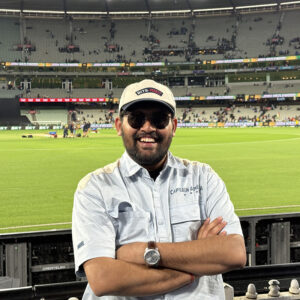
“Two and a half years into his BITS–RMIT Cotutelle PhD journey, Kanwardeep is turning a once-uncertain step into a global research experience, crediting the program for shaping his confidence, independence, lifelong friendships, and vision for real-world impact.”
– Kanwardeep Singh Gahlot, PhD Candidate, BITS-RMIT Cotutelle PhD Program
Instead of being confined to a conventional research path, the program provided exactly the kind of platform he needed to expand his aspirations and move forward with greater confidence. Being trained across the academic cultures of India and Australia has broadened his outlook and helped him understand research from multiple dimensions, strong theoretical foundations, practical engineering challenges, industry relevance, and societal impact. This dual exposure has encouraged him to think more independently, question more deeply, communicate more confidently, and approach problems with a stronger sense of purpose.
Kanwardeep believes that one of the strongest aspects of the BITS–RMIT program is the way its research projects are designed around meaningful real-world challenges. The program brings together the requirements, strengths, and dynamic conditions of both India and Australia, while encouraging students to think beyond traditional approaches and contribute to next-generation applications. During the selection process, Kanwardeep was selected for two research projects, which made the final choice both exciting and difficult. He eventually chose the project titled “5G Enabled Smart Vehicular Communications for Autonomous Driving”, an area that is now highly active in India, Australia, and across the world as researchers and industries rethink how future transportation systems will operate. He is deeply grateful to his PhD supervisors, Prof. Sandeep Joshi and Prof. Ke Wang, for shaping and supporting a PhD topic that is both technically challenging and globally relevant.
Kanwardeep spent the first eighteen months of his PhD at BITS Pilani, Pilani Campus, where he strengthened his fundamentals, developed a deeper theoretical foundation, and received strong support from his supervisors, mentors, and peers. He describes this phase as an intense and highly rewarding experience. Being at BITS during the early stage of his PhD made him realize that even after completing a master’s degree, there is still so much to learn, question, and explore. For him, this environment nurtured curiosity, discipline, and an inquisitive mindset, which he considers essential qualities for any research candidate.
His time at RMIT University has been one of the most delightful and enriching phases of his recent years. Kanwardeep describes his transition from India to Australia as smooth and well-supported, made possible through careful planning by his supervisors and the warm welcome he received from Ms. Nicole Woodham and the wider RMIT team. Living in Melbourne, a diverse and cosmopolitan city, has allowed him to experience not only Australian culture but also the feeling of being connected to the wider world in one place. The research culture at RMIT, with its openness to questioning, freedom to take initiative, and encouragement to lead ideas even as a PhD candidate, has given him exposure well beyond research. The kindness, support, and warmth he has received from people across Australia have also shaped him personally, making him not only a better researcher but also a more grounded and confident individual.
On a personal note, coming from a country where cricket is deeply loved, Kanwardeep’s time in Australia also brought experiences he had once only imagined. During his stay, he had the opportunity to play for the A Reserves at Flemington Colts Cricket Club, watch matches at the iconic Melbourne Cricket Ground, and even meet Pat Cummins, the Australian cricket captain. These moments felt like a dream and added a special personal dimension to his journey. Through this program, he also made friends from across the globe, watched the Australian Open, developed a habit of eating Tim Tams, and found himself saying “mate” and “no worries” more often than expected.
For Kanwardeep, the PhD has not been a boring or isolated journey. It has been a transformative experience of learning, building, travelling, collaborating, and discovering how research can create value beyond the lab. The BITS–RMIT Cotutelle PhD program has shaped him not only as a PhD candidate, but also as an independent researcher and emerging field expert. It has given him the confidence to take ideas beyond the laboratory, connect academic research with real-world applications, and contribute to technological progress with a broader vision.
For him, this program represents much more than a research degree. It has been a journey of learning how to think, question, build, and create meaningful impact through research.